

Visual abstract
Palabras clave
Cómo citar
Cited by


Resumen
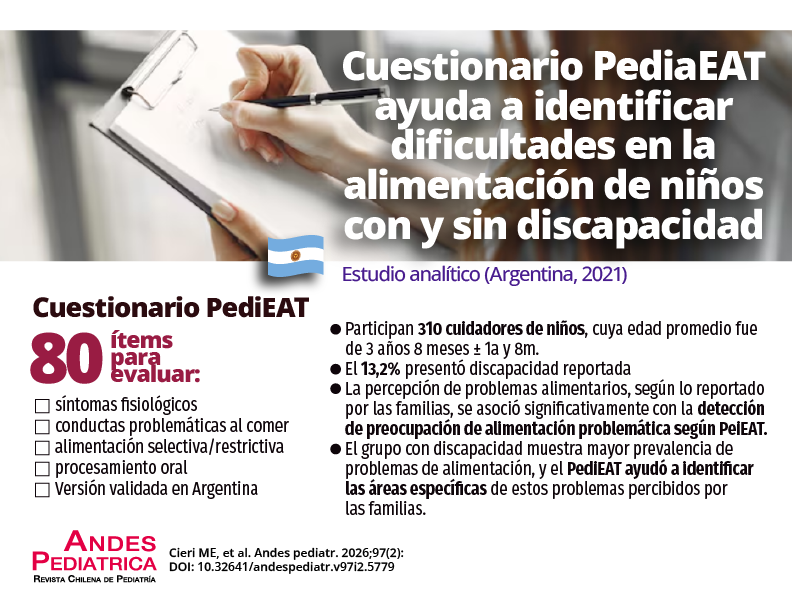
Las dificultades alimentarias son comunes en la infancia. El cuestionario PediEAT permite identificar problemas de alimentación hasta los 7 años.
Objetivo: Evaluar los síntomas asociados a la alimentación problemática observables por las familias y/o cuidadores de niños/as argentinos/as de 6 meses a 7 años que consumen alimentos sólidos a través de la herramienta PediEAT, con y sin discapacidad reportada.
Sujetos y Método: Estudio observacional, analítico y transversal. Se realizó un muestreo secuencial. Se utilizó el cuestionario autoadministrado PediEAT previamente adaptado y validado, en familias y/o cuidadores de niños/as de 6 meses a 7 años que consumieran alimentos sólidos. Se analizó edad, estado nutricional, características socioeducativas y dimensiones del PediEAT. Se compararon las dimensiones del cuestionario según aquellos que sus cuidadores percibían una alimentación problemática y aquellos que no. Las variables categóricas se evaluaron con la prueba Chi2 con corrección de Fisher con un valor de p < 0,05.
Resultados: Ingresaron al estudio 310 sujetos cuya edad promedio fue de 3 años 8 meses ± 1a y 8m. El 13,2% presentó discapacidad reportada y el 41,3% (IC95% [35,8-47,0]) de los cuidadores de los niños/as mencionaron que sí percibían alimentación problemática o no estaban seguros de percibirla. El 39% (IC95% [33,5-44,7]) tenía malnutrición por exceso y por déficit. En comparación con el grupo sin discapacidad reportada, el grupo con discapacidad mostró más preocupación en las dimensiones síntomas fisiológicos (p = 0,009), alimentación selectiva/ restrictiva (p = 0,033) y procesamiento oral (p < 0,0001). La percepción de problemas alimentarios, según lo reportado por las familias, se asoció significativamente con la detección de preocupación de alimentación problemática según PediEAT (p < 0,001).
Conclusiones: El grupo con discapacidad muestra mayor prevalencia de problemas de alimentación, y el PediEAT ayudó a identificar las áreas específicas de estos problemas percibidos por las familias.

Esta obra está bajo una licencia internacional Creative Commons Atribución 4.0.
Derechos de autor 2026 Maria Elisabeth Cieri, Ana Laura Condinanzi, Carla Gil, Gabriela Macagno, Eduardo Cuestas, María de las Mercedes Ruiz Brunner