
Visual abstract
Keywords
How to Cite
Cited by


Abstract
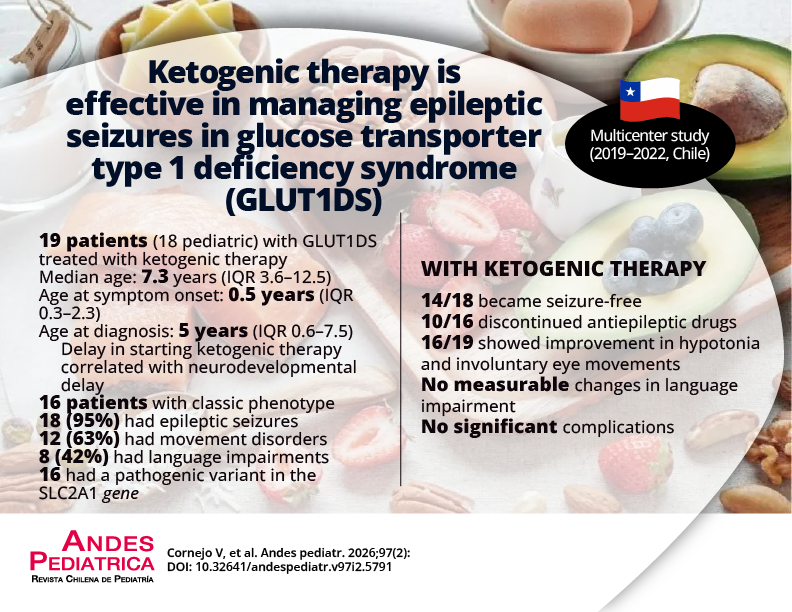
Glucose transporter type 1 deficiency syndrome (GLUT1DS), caused by variants in the SLC2A1 gene, causes conditions ranging from refractory epilepsy to movement disorders. Treatment consists of ketogenic therapy (KT).
Objective: To characterize a cohort of patients with GLUT1DS undergoing KT, in follow-up at a national reference center in Chile.
Patients and Method: A retrospective cohort study was conducted. Data were collected from clinical records, and the treating neurologists were consulted regarding phenotype, genotype, and clinical evolution following KT. A descriptive analysis was performed (median with interquartile range [IQR]) and Spearman correlation.
Results: Nineteen patients were analyzed, with a median age of 7.3 years (IQR: 3.6-12.5). Symptom onset occurred at 0.5 years (IQR: 0.3-2.3); 16 patients presented with the classic phenotype. Eighteen patients (95%) experienced epileptic seizures, 12 (63%) had movement disorders, and 8 (42%) had language disorders. Diagnosis was established at 5 years (IQR: 0.6-7.5). In 16/19 patients, variants were identified in the SLC2A1 gene. Significant negative correlations were observed between the interval from symptom onset to treatment initiation and the psychomotor development index (r = –0.82), verbal intelligence quotient (r = –0.73), and total intelligence quotient (r = –0.68). Following the initiation of KT, 14/19 patients became seizure-free, and 10/16 discontinued antiepileptic drugs. Modified KT (14/19) and malnutrition due to excess (11/19) predominated. Five patients developed mixed dyslipidemia.
Conclusion: Ketogenic therapy was effective in managing epileptic seizures in GLUT1DS. Early diagnosis and timely initiation of KT should improve neurological prognosis.

This work is licensed under a Creative Commons Attribution 4.0 International License.
Copyright (c) 2026 Verónica Cornejo Espinoza, Cecilia Baeza Lara, José Marín Medina, Valentina Parga Concha, María Jesús Leal-Witt, María Gabriela Crespo De Diego, Claudia Castiglioni Toledo, Bernardita Suárez Squadritto, Carmen Pérez Nuñez, Lorena Pizarro Ríos, Ximena Carrasco Chaparro, Erna Loreto Rios-Pohl, Francisca López Avaria, Sebastián Vega Toro, Daniela Navarrete Balart, Carmen Vargas Leal, Juan Francisco Cabello Andrade, Carolina Arias Pefaur, María Florencia Salazar Silva