

Visual abstract
How to Cite
Cited by


Abstract
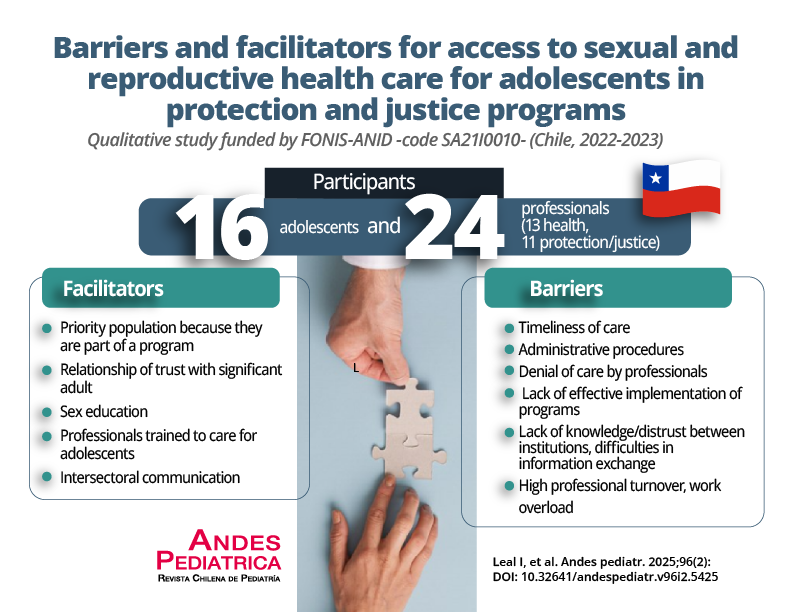
Sexual and reproductive health (SRH) of adolescents in Chile faces significant challenges. Despite progress, gaps in access to services persist, especially for groups whose rights have been violated, such as adolescents who attend protection and justice programs.
Objective: To analyze the barriers and facilitators of access to sexual and reproductive health services in Primary Health Care for adolescent women who attend protection and justice programs in the Metropolitan Region of Chile.
Subjects and Method: Qualitative and exploratory research with intentional sampling of adolescent women in protection and justice programs, and primary care professionals and those of the programs. Semi-structured qualitative interviews were conducted. The analysis was carried out using a constructivist thematic approach, establishing a categorization and coding system.
Results: 16 adolescents and 24 professionals were interviewed. The adolescents identified the following barriers to accessing services: opening hours, the obligation to attend with an adult when they are minors, lack of knowledge about administrative procedures and long waiting times. The professionals pointed out difficulties such as insufficient implementation of adolescent health policies and programs, high staff turnover, work overload and problems in intersectoral coordination. They also highlighted the mutual mistrust, prejudices and lack of knowledge between the health, protection and justice systems, the stigmatization of adolescent users, and the perception of this population as “complicated” to care for. They also emphasized the lack of awareness of those working in health regarding problems of rights violations. Among the facilitators, the recognition of the status as a priority population, the relationship of trust with the teams, educational interventions on sexuality, legal regulations that guarantee confidentiality, and the role of the professional in charge of intersectoral coordination, were key elements to improve access to health services.
Conclusions: There are institutional barriers that hinder access by adolescents from protection and justice programs to sexual and reproductive health services in primary care. Knowledge and effective implementation of public policies that prioritize this population represent a key facilitator.

This work is licensed under a Creative Commons Attribution 4.0 International License.
Copyright (c) 2025 Revista Chilena de Pediatría