

Visual abstract
Keywords
How to Cite
Cited by


Abstract
Studies on the association between nutritional diagnosis and outcomes in critically ill children show mixed results.
Objective: To evaluate nutritional status and determine its association with outcomes in a Pediatric Intensive Care Unit (PICU).
Patients and Method: Retrospective cohort study at the National Institute of Child Health, Peru. We assessed nutritional status at admission using weight/ height (< 2 years) and BMI for age (≥ 2 years), and determined its association with mortality, PICU length of stay, mechanical ventilation (MV), ventilator-free days, and healthcare-associated infections. We excluded children with diagnoses that affected anthropometry due to non-nutritional causes. We applied bivariate analysis and adjusted Poisson regression.
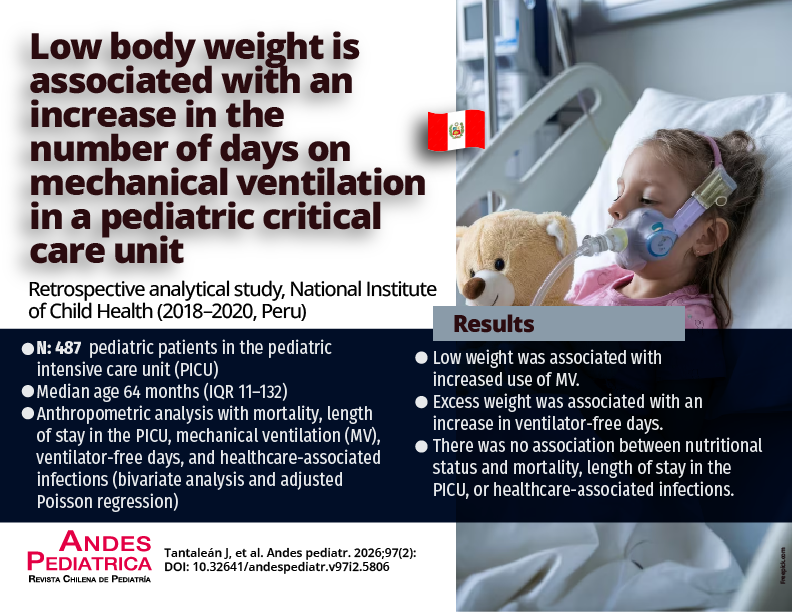
Results: In 487 patients, 13.1% were underweight and 23% were overweight. In bivariate analysis, underweight children had less ventilator-free days (21 days vs 25 days; p = 0.0101) and longer ICU stay (8 days vs 5.5 days; p = 0.0153). In the regression analysis, underweight children had a 15% and 21% higher risk of requiring MV compared to children of normal weight and overweight (RR: 0.85; IC: 0.75-0.94 and 0.79; IC: 0.69-0.91, respectively; p = 0.001). Overweight children had more ventilator-free days compared to those underweight (RR: 1.11; CI: 1.01-1.21; p = 0.018). Mortality, healthcare-associated infections, or PICU stay were not associated with nutritional diagnosis.
Conclusions: Underweight was correlated with greater use of MV, while overweight was related to an increase in ventilator-free days. There was no association between nutritional status and mortality, length of stay, or healthcare-associated infections.

This work is licensed under a Creative Commons Attribution 4.0 International License.
Copyright (c) 2026 José Tantaleán Da Fieno, Rosa León Paredes, Patricia Palomo Luck, Emiliana Rizo Patrón Terrero, Carlos Del Águila Villar