

Visual abstract
How to Cite
Cited by


Abstract
Biological therapies have improved the prognosis of patients with inflammatory diseases. In adults, an increased risk of presenting infections has been reported, however, there are few pediatric studies.
Objective: To describe the incidence of infections in pediatric patients using biological therapies.
Patients and Method: Retrospective cohort study of pediatric patients with rheumatic diseases and inflammatory bowel diseases, treated with biological therapies, at the UC-Christus Health Network between 2007-2019. The number, type, and characteristics of mild and serious infections (hospitalization requirement, use of intravenous antimicrobials, association with mortality) were recorded. Descriptive statistics were used.
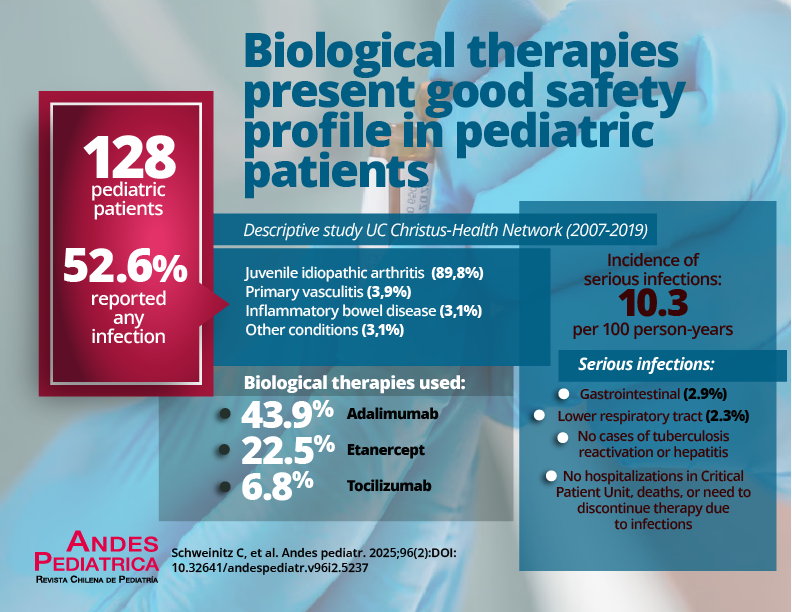
Results: We included 128 patients diagnosed with juvenile idiopathic arthritis (89.8%), primary vasculitis (3.9%), and inflammatory bowel disease (3.1%). Adalimumab was used in 43.9%, Etanercept in 22.5%, and Tocilizumab in 16.8% of patients. 52.6% of patients reported an infection. The most common mild infections were upper respiratory tract infections (61.5%) and lower respiratory tract infections (10.6%). The most frequent severe infections were gastrointestinal infections (2.9%) and lower respiratory tract infections (2.3%). The incidence rate of mild infections was 119.7 (CI 106-128) per 100 person-years and the incidence rate of severe infections was 10.3 (CI 73.7-142.1) per 100 person-years. No cases of reactivation of tuberculosis or hepatitis B virus were observed. There were no hospitalizations in intensive care units, deaths, or need to suspend biological therapy due to infections.
Conclusions: This study shows that biological therapies have a good safety profile, without reports of significant repercussions during infections, regardless of the underlying pathology.

This work is licensed under a Creative Commons Attribution 4.0 International License.
Copyright (c) 2025 Revista Chilena de Pediatría