

Visual abstract
Keywords
How to Cite
Cited by


Abstract
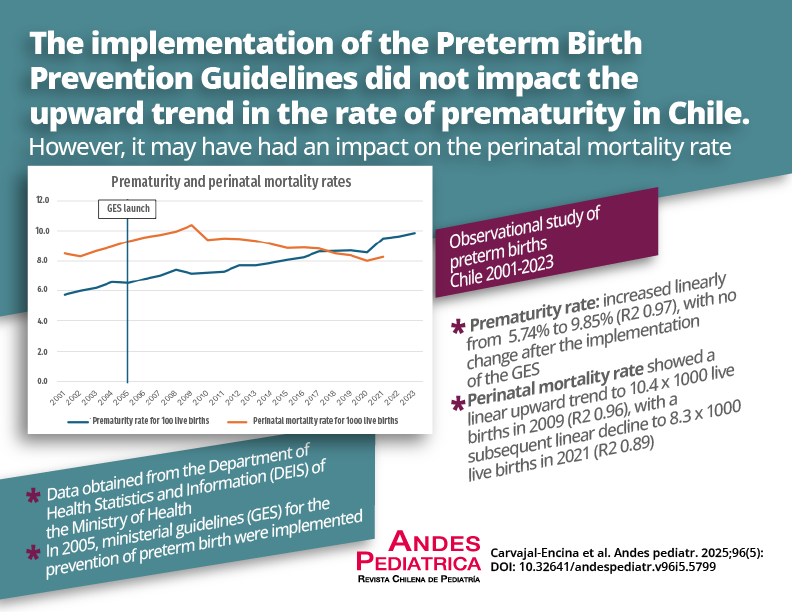
Prematurity is a challenge due to its high morbidity and mortality. The Explicit Health Guarantees (GES) for Premature Birth Prevention, implemented in 2005, have not been evaluated.
Objective: To evaluate the impact of the GES on perinatal indicators.
Patients and Method: Cross-sectional study of premature births between 2001 and 2023, including both stillbirths and live births (LB) ≥ 22 weeks’ gestational age. Data were obtained from the Department of Health Statistics and Information of the Ministry of Health databases. Prematurity rate (PR), perinatal mortality rate (PMR), fetal mortality rate (FMR), and early neonatal mortality rate (ENMR) were analyzed using linear regression, time series, and 5-year forecasting using ARIMA models.
Results: The PR increased linearly from 5.74% to 9.85% (R2 = 0.97), with no changes after the implementation of the GES. The risk of prematurity increased by 49% between the pre-GES five-year period and the most recent one. The PR forecasting showed a continued upward trend, reaching 10.6 per 1,000 LB in 2027 (95% CI: 9.9-11.3). The PMR showed a linear upward trend reaching 10.4 per 1,000 LB in 2009 (R2 = 0.96), followed by a linear decline to 8.3 per 1,000 LB in 2021 (R2 = 0.89), explained by a decrease in FMR and stable ENMR. The PMR forecasting showed a sustained trend (2026: 5.8 per 1,000 LB; 95% CI: 5.8-9).
Conclusions: GES did not reduce PR but was associated with lower PMR. This potential impact requires further analysis to establish causality and guide future improvements.

This work is licensed under a Creative Commons Attribution 4.0 International License.
Copyright (c) 2025 Fernando Carvajal-Encina, Luciano Carvajal Rojas