

Visual abstract
Keywords
How to Cite
Cited by


Abstract
The growing complexity of healthcare systems demands innovative strategies to strengthen collaborative work, particularly in breastfeeding, where clinical, social, and cultural factors converge. In this context, Interprofessional Collaborative Clinical Simulation (ICCS) has emerged as a promising methodology to promote learning in safe and reflective environments.
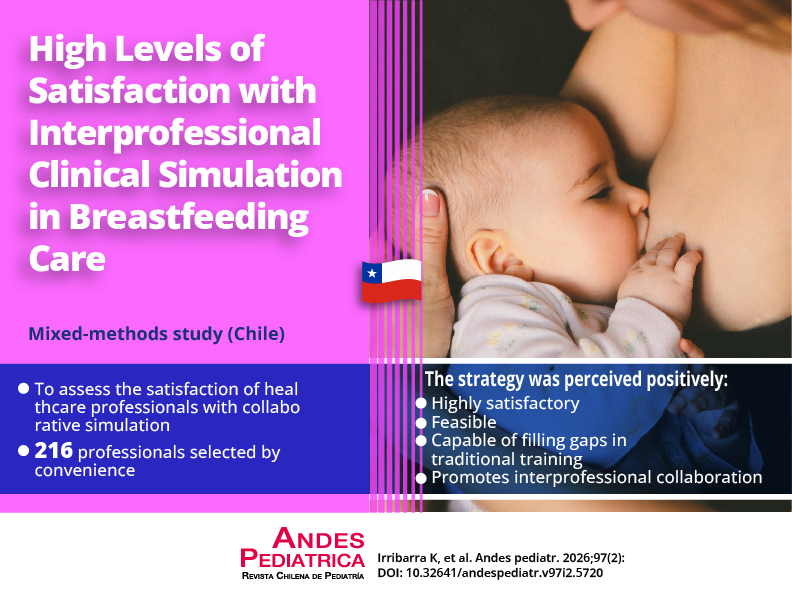
Objective: To evaluate the satisfaction of health professionals with the learning experience generated through an ICCS in a continuing education program on breastfeeding.
Methods: Quantitative study with an exploratory qualitative component, and a cross-sectional, non-experimental design. The sampling method was by convenience and included 216 public health professionals. The intervention was carried out in high-fidelity scenarios organized into 27 interprofessional groups. Satisfaction was measured using a validated questionnaire and an open-ended question. Quantitative data were analyzed with descriptive statistics and instrument reliability using Cronbach’s alpha, while qualitative data were examined through open coding and constant comparisons. Results: 93.1% of participants scored maximum satisfaction. Qualitative analysis identified six key dimensions: interprofessional coordination, clinical communication, collaborative learning, emotional development, debriefing appraisal, and clinical applicability. Triangulation demonstrated consistency between both approaches, reinforcing the robustness of the findings.
Conclusions: ICCS was perceived as highly satisfactory and feasible, addressing gaps in traditional training and strengthening interprofessional collaboration in breastfeeding care.

This work is licensed under a Creative Commons Attribution 4.0 International License.
Copyright (c) 2026 Karen Irribarra, Mackarena Fernández-S, Macarena Rodríguez, Miguel Sagredo