

Visual abstract
How to Cite
Cited by


Abstract
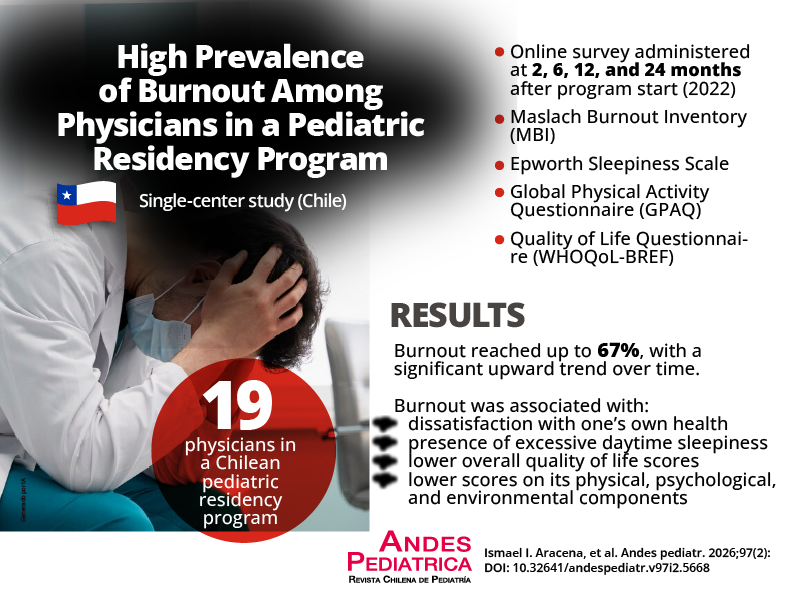
Medical residency is a training phase associated with changes in well-being indicators such as sleepiness, physical activity, quality of life, and burnout.
Objective: To determine the evolution of well-being aspects in pediatric residents during the first two years of residency.
Subjects and Method: An online survey was administered to pediatric residents at the Pontifical Catholic University of Chile who entered the program in 2022, at 2, 6, 12, and 24 months after starting the program. The survey included the Maslach Burnout Inventory, the Epworth Sleepiness Scale, the Global Physical Activity Questionnaire, and a quality-of-life questionnaire (WHOQoL-BREF).
Results: 19 residents were included in this study. 15, 14, 13, and 9 residents completed the survey at each respective time point. The prevalence of burnout reached up to 67%, with a significant upward trend over time. Burnout was associated with lower levels of satisfaction with health, excessive daytime sleepiness, poorer overall quality of life, and lower scores in the physical, psychological, and enviromental domains of
quality of life. Conclusions: Pediatric residents have a high prevalence of burnout, which is associated with sleepiness and lower quality of life. Monitoring residents using these tools can contribute to designing interventions within residency programs to mitigate burnout.

This work is licensed under a Creative Commons Attribution 4.0 International License.
Copyright (c) 2026 Ismael I. Aracena-Valdes, Felipe T. Reyes, Carolina A. Serrano