

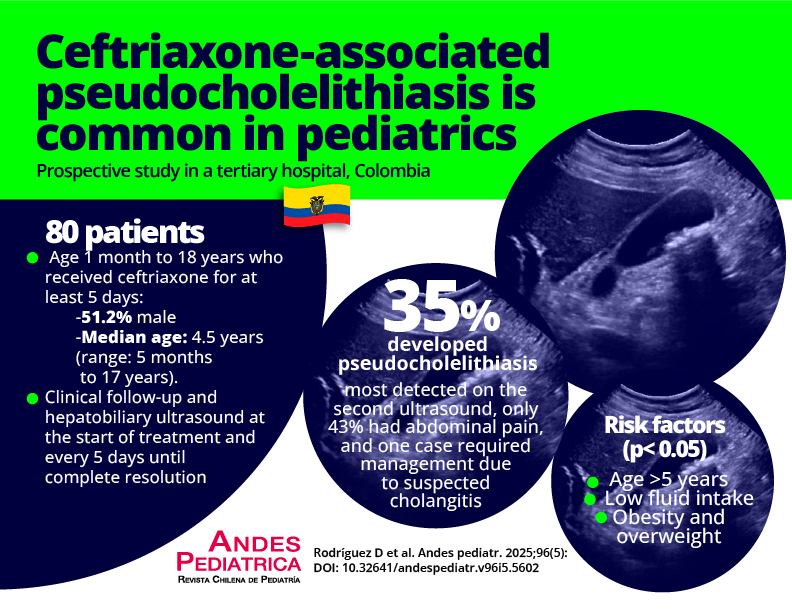
Visual abstract
How to Cite
Cited by


Abstract
Ceftriaxone-associated pseudocholelithiasis is common but underdiagnosed in children, occurring in up to half of those receiving ceftriaxone. Although self-limiting, it is frequently accompanied by symptoms.
Objective: To report the incidence, course, risk factors, and clinical behavior of pseudocholelithiasis in children receiving ceftriaxone.
Patients and Method: Prospective, descriptive, observational case series study. Patients aged 1 month to 18 years who received ceftriaxone were included. Clinical follow-up and hepatobiliary ultrasound were performed at the start of treatment and every 5 days until complete resolution. Association with risk factors was explored. Statistics used included Pearson’s chi-square test and Fisher’s exact test.
Results: Eighty patients were included, 51.2% were male, median age 4.5 years (range 5 months to 17 years). The prevalence of pseudocholelithiasis was 35% (28 patients), documented in 6 and 27 patients during the first and second ultrasound (21.4% and 96.4%). Pseudocholelithiasis was significantly more frequent in the age group older than 5 years, those with lower fluid intake, obese, overweight, and very rare in malnourished patients (all p < 0.05). Twelve patients presented abdominal pain as a cardinal symptom (42.9%). The mean duration of the stones was 19.1 (5-44) days.
Conclusion: Ceftriaxone-associated pseudocholelithiasis is common, occurring in 1 out of 3 children who receive it. Its main risk factors were age over 5 years, lower fluid intake, overweight, and obesity. Abdominal pain is frequent, and the progression was self-limited.

This work is licensed under a Creative Commons Attribution 4.0 International License.
Copyright (c) 2025 Revista Chilena de Pediatría