

Visual abstract
How to Cite
Cited by


Abstract
Categorizing the complexity of Children and Youth with Special Health Care Needs (CYSHCN) could be useful in guiding their need for pediatric palliative care (PPC). However, there are no studies that have evaluated this association.
Objective: To evaluate the association between clinical complexity and the requirement for PPC in CYSHCN.
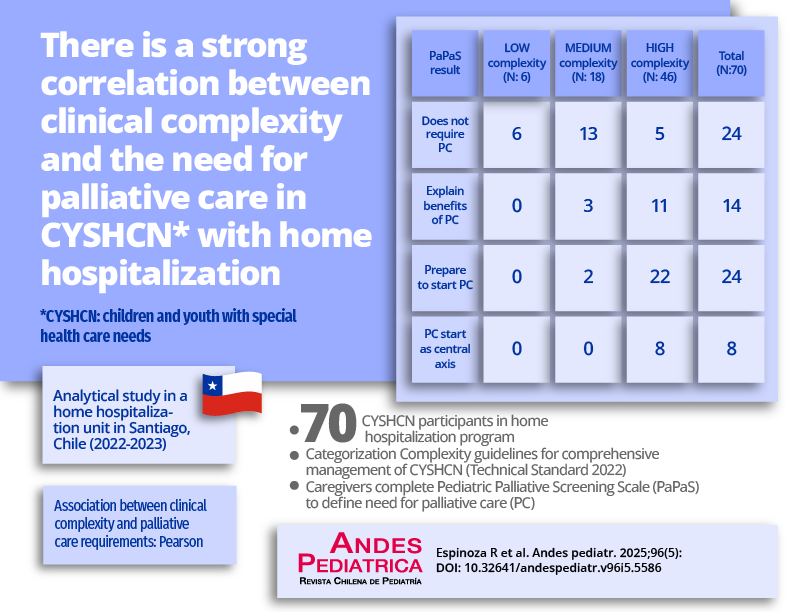
Patients and Method: Observational, cross-sectional, and descriptive study. Data were collected between 2022 and 2023 at the CYSHCN Home Hospitalization Unit of the Hospital Clínico San Borja Arriarán. Non-probabilistic convenience sampling. Patients were categorized according to complexity guidelines for CYSHCN as low, medium, or high; and the “Paediatric Palliative Screening Scale” (PaPaS Scale) was applied to evaluate the need for PPC, categorizing them into: no need for PPC; explain the objectives of PPC to caregivers; prepare the start of PPC, and start the intervention as the central axis of management.
Results: 70 CYSHCN patients were studied, 6 (8.57%) correspond to low complexity, 18 (25.7%) to medium, and 46 (65.7%) to high complexity. Of those studied, 24 (34.2%) did not require intervention, and 46 (65.7%) required PPC with varying degrees of intensity. The association between clinical complexity and the need for PPC had a Pearson correlation coefficient of 0.8225.
Conclusion: There is a strong correlation between clinical complexity and the need for PPC in CSHCN in follow-up by the CYSHCN Home Hospitalization Unit. All patients in this study who require intensified palliative care are high-complexity CYSHCN.

This work is licensed under a Creative Commons Attribution 4.0 International License.
Copyright (c) 2025 Revista Chilena de Pediatría