

Visual abstract
Keywords
How to Cite
Cited by


Abstract
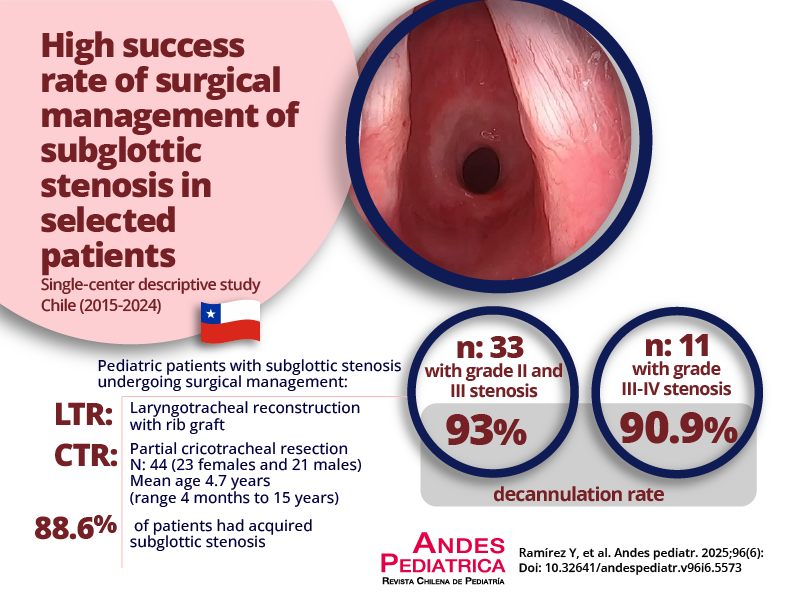
Subglottic stenosis (SGS) can be either congenital or acquired. Acquired SGS is more frequent and is mainly caused by prolonged intubation. Treatment includes laryngotracheal reconstruction (LTR) with anterior and/or posterior rib graft, partial cricotracheal resection (PCTR), and endoscopic dilatation.
Objective: To describe and analyze the characteristics, surgical outcomes, and postoperative complications of the pediatric population with SGS surgically treated.
Patients and Method: Retrospective study of surgical outcomes and postoperative complications of 44 pediatric patients with SGS treated with LTR or PCTR between 2015 and 2024 in a tertiary pediatric hospital.
Results: 88.6% of patients presented acquired SGS. LTR was performed in 33 patients with grade II and III SGS with a success rate of 93%. PCTR was performed in 11 patients with SGS grade III- IV, with a success rate of 91%.
Conclusion: LTR as well as PCTR are safe and effective options for the treatment of SGS in children. Surgical success depends on specialized, individualized, and multidisciplinary care.

This work is licensed under a Creative Commons Attribution 4.0 International License.
Copyright (c) 2025 Revista Chilena de Pediatría